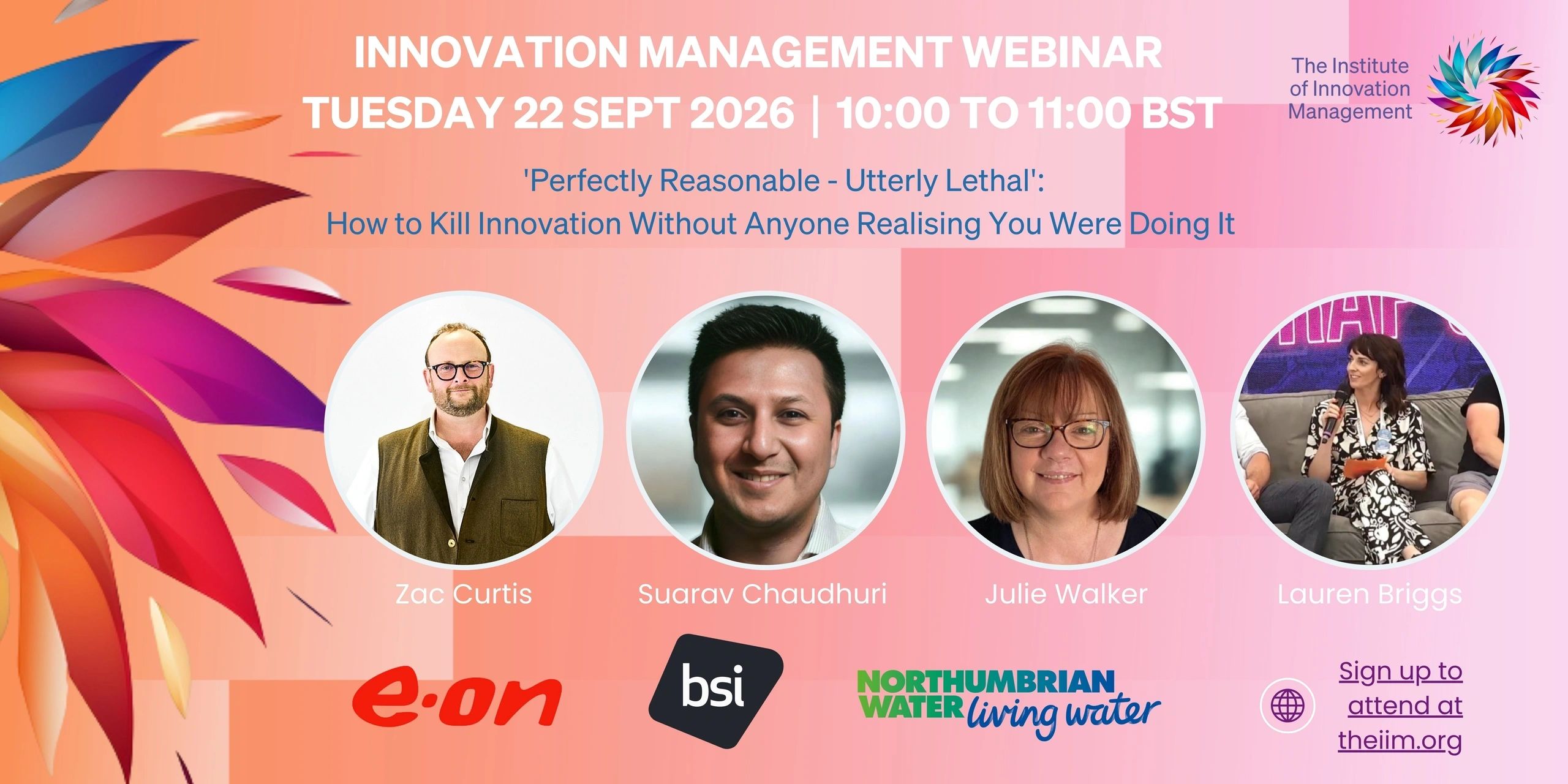
How reasonable controls can quietly suffocate innovation, and how to redesign discipline for uncertainty
Innovation does not always die in a dramatic confrontation. Sometimes it is asked to wait for the next board meeting. Sometimes it is sent back for a five-year business case before anyone has tested the underlying assumption. Sometimes every hour must be charged to a project code before a team can explore what the project might become.
That was the uncomfortable insight behind one of the webinar’s most memorable exercises. Saurav Chaudhuri asked participants to imagine themselves as ‘malevolent agents’, parachuted into a rival organisation to destroy its innovation projects without being caught, and to do so using normal company management techniques.
The responses were funny because they were familiar: create an ideas box and never respond; require full-board sign-off; wait indefinitely for budget approval; declare the pipeline full; insist on rigid budgeting; demand a watertight five-year commercial case; or require every hour to be booked to a project code.
The lesson for innovation professionals is not that governance, finance, procurement or assurance are the enemy. It is that controls designed for predictable delivery can become lethal when applied unchanged to work whose purpose is to reduce uncertainty. The professional challenge is to keep appropriate discipline while changing its timing, evidence requirements and decision rights.
1. Stop treating innovation as spare-time work
Lauren Briggs described a culture in which innovation was not confined to a specialist team. Northumbrian Water had innovation as one of its five core values, around 200 innovation ambassadors across roles and departments, and visible leadership support for its innovation activity. Her underlying point was direct: if an organisation relies on one innovation team, it is building a team, not necessarily an innovative culture.
Zachary Curtis added a useful way to diagnose that culture: the engine, the environment and the enablers. The engine includes processes and governance; the environment includes physical conditions and leadership permission; and the enablers include capability and training.
I think innovation without protected capacity is essentially a side of desk exercise.
— Zachary Curtis
This matters because permission to innovate must include permission to learn that an idea should not proceed. The surrounding culture should enable people to deliver an experiment, but also give them permission not to deliver the expected result if the evidence points elsewhere.
A practical test for the coming week is simple: choose one initiative and ask where its protected capacity actually exists. Is time explicitly available? Has a leader authorised the trade-off with operational work? Does the team have permission to report a negative result? If the honest answer is ‘people will fit it in’, the organisation has not resourced innovation; it has outsourced the cost to individual commitment.
2. Make governance proportionate to what is known
At the exploratory front end, Curtis argued for space to play, collaborate and test lightly before locking an initiative into fuller governance. The purpose is not to avoid accountability but to find a stronger version of the problem and potential solution before applying delivery-stage controls.
The opposite approach appeared repeatedly in the ‘Malevolent Agent’ discussion: board-level approval that could leave a team waiting for months, a requirement for a watertight five-year commercial case before testing, or a financial coding structure that constrains work before its shape is understood.
You do not need a business case to get something started.
— Saurav Chaudhuri
Chaudhuri explained that the numbers would be needed eventually, but the organisation could not credibly demand them before it knew whether the idea would work.
Briggs offered a practical alternative. Her organisation’s ‘innovation passport’ records the opportunity or problem, intended outcomes, potential risks, sponsor, success criteria and what the team hopes to learn. It is treated as a living document that can be shared with stakeholders as evidence develops, rather than as a fixed case that pretends uncertainty has already disappeared.
She also described discovering that one initiative was passing through three governance boards because it drew funding from three routes. The response was to reconsider whether processes designed for capital delivery or conventional investment were suitable for novel work. The organisation used innovation-specific stages – discovery, define, develop and deliver – to retain checkpoints while allowing learning and iteration.
For practitioners, the useful question is not ‘How can we remove governance?’ It is ‘What decision are we ready to make with the evidence available now?’ Early governance can authorise the next bounded learning step. Later governance can ask for progressively stronger evidence as exposure, investment and implementation commitments grow.
Try converting one approval pack into a learning checkpoint. Retain the sponsor, risks, intended outcomes and success criteria, but add two explicit questions: What uncertainty are we reducing next? What result would cause us to stop, adapt or proceed? That creates discipline without asking a hypothesis to masquerade as a forecast.
3. Bring control functions into the learning journey
The webinar also showed how projects can suffer ‘a thousand cuts’ without any stakeholder intending to stop innovation. Curtis described a trial in which each function had a reasonable request: procurement wanted a supplier process; cybersecurity wanted a full assessment of something not yet in existence; finance wanted a five-year case; operations wanted a support model; and brand wanted research. Together, those requests slowed the initiative enough to create concern that competitors would move first.
His response was to generate evidence where he could, sometimes by working around a blocker, obtaining external expert input or running a small test, and then returning with results. He was careful to say that this approach would not work for everyone.
The more transferable principle is involvement rather than evasion. Briggs’s innovation passport was shared with stakeholders early so they could follow the learning journey instead of encountering a finished proposal and being asked for immediate certainty.
Later in the discussion, she argued for co-creating the problem and recognising that people contribute to innovation in different ways, as critical thinkers, realists or idealists, not only as originators of ideas.
So we had an idea, but they made it real.
— Saurav Chaudhuri
In one proposition, the colleagues who installed, operationalised and commercialised the offer were not necessarily involved at the very beginning, but they were brought in when their knowledge could shape a feasible route to market.
This suggests a better stakeholder question than ‘Who must approve?’ Ask instead: Who can improve the problem definition, the test, the evidence or the implementation, and when should they enter? An effective stakeholder map should assign a contribution and timing, not only an approval status.
4. Do not confuse ‘tried before’ with ‘never again’
One audience tactic for killing innovation was to say that an idea had already been tried and had failed. Curtis responded with Ovo’s Power Move proposition: he said the idea had been formulated within SSE several years earlier but was not implemented then, before a substantially similar proposition was launched later when the timing and market were more favourable.
Briggs recognised the same pattern internally: ideas can reappear because the underlying problem has become more urgent, priorities have shifted, or a more tenacious champion is now available. In her view, an initiative can die because it lacks the right person to push it through, not only because the idea itself is weak.
The practical implication is to distinguish rejection from readiness. When an initiative is paused, record why: inadequate evidence, poor timing, the wrong owner, insufficient capability, competing priorities or a genuine flaw in the proposition. Then state what would need to change before it is reconsidered. That turns organisational memory into a resource instead of a veto.
The IIM perspective: discipline for uncertainty
The session’s examples point to a broader professional requirement. Innovation Management cannot depend only on heroic individuals going ‘rogue’, nor can it rely on enthusiasm without structure. It needs a recognised organisational capability: leaders who provide mandate and air cover; practitioners who can frame and test uncertainty; governance that escalates evidence requirements appropriately; and stakeholders who understand how their expertise contributes.
Victoria Milne linked this directly to IIM’s purpose: developing a body of knowledge and appropriate ways of working so that Innovation Management becomes a recognised profession, practitioners have the right mandate and skills, and organisations understand the discipline more clearly.
Julie Walker also presented ISO 56001 as a framework that can help organisations consider leadership, culture, support, processes and measurement, not as a mechanism for adding restriction.
That distinction is important. A systematic approach should not eliminate uncertainty by pretending it does not exist. It should create a controlled way to learn through it.
A practical conclusion
The fastest way to find hidden barriers may be to borrow the webinar’s inversion exercise. Gather a small cross-functional group and ask: If we wanted to kill this initiative using only normal management practices, what would we do?
Then look at the resulting list. If it resembles current reality, choose one change: protect a defined slice of team capacity, replace a premature business case with a learning checkpoint, consolidate duplicated governance, or involve one stakeholder earlier with a clear contribution. These are modest interventions, but they address the system around innovation rather than demanding more resilience from the people trapped inside it.
Watch the full webinar recording to hear the panel’s examples and the audience’s ‘Malevolent Agent’ contributions in context.