Webinar Recording Now Available
In a world defined by geopolitical volatility, shifting markets, and accelerating technological change, organisations face increasing pressure to adapt quickly and decisively. For many, the challenge is not a lack of ideas — but the absence of a structured, systematic approach that connects innovation activity with organisational performance.
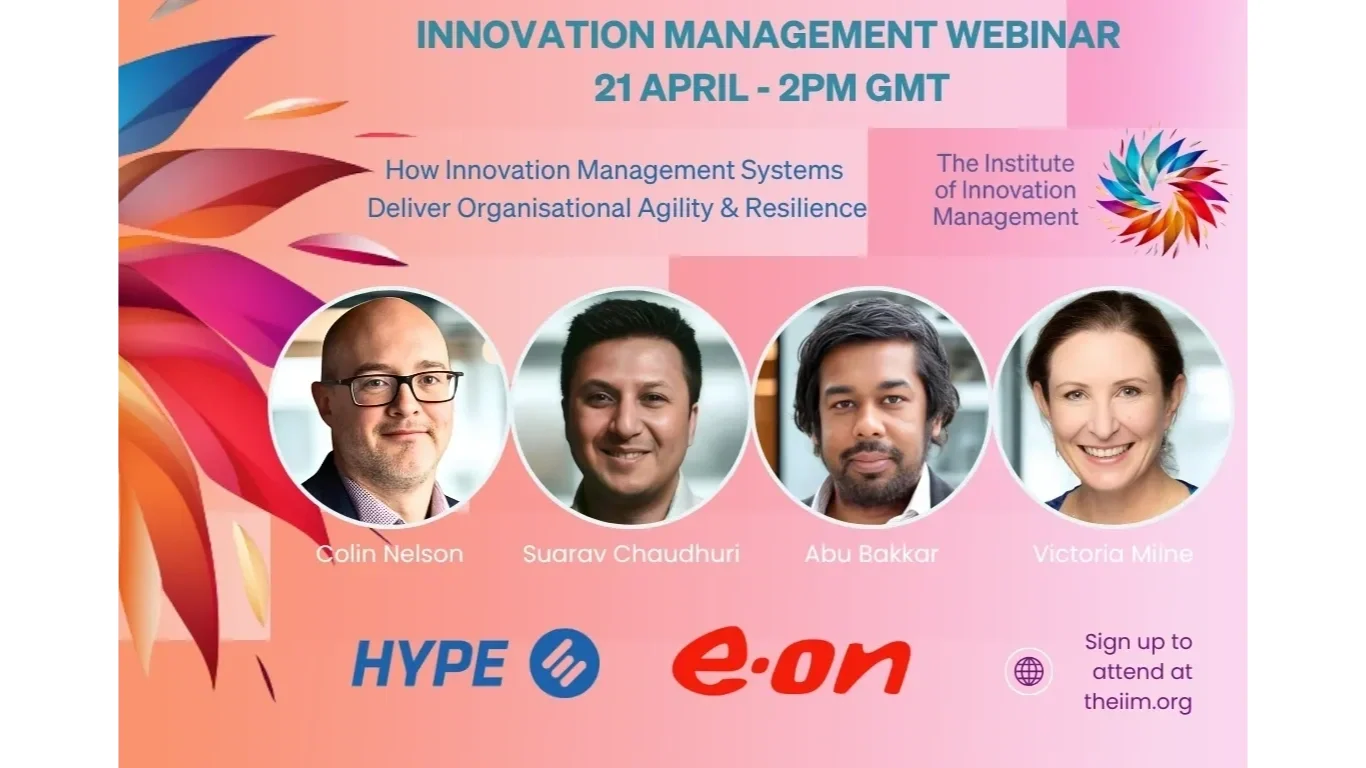
In this latest session of the IIM Webinar Series, delivered in partnership with HYPE Innovation and E.ON UK, leading Innovation Management professionals explored how Innovation Management Systems (IMS) provide the foundations for agility, resilience, and long‑term competitiveness.
A Conversation Focused on Practical, Systematic Innovation
Hosted by Victoria Milne (IIM), the webinar brought together a panel of experienced practitioners:
- Colin Nelson, HYPE Innovation
- Saurav Chaudhuri, E.ON UK
- Abu Bakkar, HLB International
Together, they examined how organisations — particularly those with mid‑to‑lower innovation maturity — can use structured IMS approaches to strengthen responsiveness, reduce friction, and build the capability to innovate under sustained pressure.
The discussion emphasised that agility is not accidental. It emerges when organisations have:
- Clear innovation governance
- Defined processes and decision pathways
- Integrated digital tools
- A culture that supports experimentation and learning
- Leadership alignment around strategic priorities
These elements form the backbone of an Innovation Management System — enabling organisations to move from ad‑hoc activity to repeatable, scalable innovation performance.
Innovation Maturity as a Predictor of Resilience
A central theme of the session was the link between innovation maturity and organisational resilience.
The speakers highlighted that organisations with lower maturity often struggle with:
- Fragmented innovation efforts
- Slow decision-making
- Limited cross-functional collaboration
- Difficulty prioritising ideas and initiatives
- Reactive rather than proactive innovation behaviour
By contrast, organisations with structured IMS approaches demonstrate:
- Faster response to market or regulatory change
- Stronger alignment between strategy and innovation activity
- Better resource allocation
- More consistent delivery of innovation outcomes
- Increased confidence in navigating uncertainty
This maturity–resilience connection is becoming increasingly important as organisations face rapid shifts in technology, customer expectations, and global operating environments.
AI: Enabler, Accelerator — and Emerging Risk
The panel also explored the dual role of Artificial Intelligence in modern innovation systems.
AI is rapidly becoming a powerful enabler — supporting foresight, ideation, portfolio management, and decision intelligence. But it also introduces new risks, including:
- Over‑reliance on automated insights
- Ethical and governance challenges
- Increased exposure to misinformation
- The need for new skills and capabilities
The speakers emphasised that AI should be integrated into IMS thoughtfully, with clear governance and human oversight, ensuring it strengthens rather than destabilises innovation performance.
Why Innovation Management Systems Matter Now More Than Ever
The session concluded with a clear message: organisations cannot rely on sporadic creativity or isolated initiatives. Agility and resilience come from systematic innovation, supported by:
- Robust processes
- Clear governance
- Digital platforms
- Cross‑functional collaboration
- Strategic alignment
Innovation Management Systems provide the structure that enables organisations to innovate consistently — not just when conditions are favourable, but when they are most challenging.
Watch the Full Recording
The full webinar recording is now available for IIM members and partners.